Commitment to Sustainability
PWT Brands is dedicated to ensuring responsible and sustainable business practices. We expect all our suppliers and business partners to maintaining high standards in environmental responsibility, human rights, anti-corruption and product safety. We value long-term partnerships built on transparency, accountability, and continuous improvement.
The following requirements apply to all suppliers and any sub-suppliers used.
PWT Brands’ Policy Framework
- CSR Policy: Please read our overall CSR Policy.
- Code of Conduct: All suppliers must sign and stamp our Code of Conduct.
- Animal Welfare Policy: Relevant suppliers must sign and stamp our Animal Welfare Policy.
- Anti-Corruption Policy: All suppliers are required to read and comply with our Anti-Corruption Policy.
- Chemical Restrictions: All suppliers must sign the Declaration of Chemical Restrictions.
Signed documents must be sent to our CSR Manager, Henriette Gade Pedersen, hgp@pwtbrands.com
Factory Approval
All new factories must be approved by PWT Brands before starting production. See requirements to new factories in the Social Compliance section.
Suppliers are not permitted to use new factories without our consent.
Use of Subcontracting Factories
Subcontracting is not permitted unless explicitly pre-approved by PWT Brands.
Full transparency regarding sub-contractors is mandatory.
Social Compliance
Amfori BSCI
All factories must have a social audit. PWT Brand prefer factories participating in the amfori BSCI audit system. SA8000 certificates and SEDEX 4-pillar audits may also be accepted. Audit rating result must be A, B or C.
When introducing a new factory, please provide a valid amfori ID number or a copy of either the SA8000 certification or SEDEX audit reports.
Bangladesh Safety Agreement
As a signatory to the International Accord, PWT Brands only accepts Bangladeshi factories enrolled in the Bangladesh Agreement on Health and Safety in the Textile and Garment Industry. Factory progress rate must be over 90%.
Non-Accord factories will not be accepted.
Environmental Compliance
Amfori BEPI
PWT Brands encourages all suppliers and sub-suppliers to actively participate in the amfori BEPI (Business Environmental Performance Initiative). We expect suppliers to conduct environmental risk assessments and to work systematically with environmental improvements.
Factories may be subject to environmental audits under the amfori BEPI framework, like social audits conducted under amfori BSCI. Participation in BEPI reflects our shared responsibility to reduce environmental impact throughout the supply chain. Other Environmental Management Systems may also be accepted.
Chemical restrictions
PWT Brands expects our suppliers to manage their chemical inventory. Suppliers shall have protocols in place for the safe handling of chemicals and make sure that employees are provided with protective equipment and relevant training in handling chemicals.
All suppliers and sub-suppliers must comply with our Declaration of Chemical Restrictions.(RSL).
PFAS ban in Denmark
According to new Danish legislation, the use of PFAS in apparel and footwear is prohibited. The limit value for Total Fluorine is set at 50 mg/kg. Our suppliers are responsible to verify whether PFAS are present in their product and to work on suitable substitutions where relevant. Upon request, supplier must provide safety data sheets for chemicals used in production of PWT products – including from sub-suppliers further down the value chain. If supplier has conducted product testing, a copy of the test report can be submitted for reference.
For further guidance, we encourage suppliers to consult the AFIRM PFAS Phaseout Guidance (available in 8 languages) and ChemSec – NGO working on substitution of harmful chemicals and alternatives.
Testing
To ensure chemical safety and regulatory compliance PWT Brands have a Testing Programme. We will conduct random tests on finished products. Products will be selected on a risk-based approach, and we will ask suppliers to send selected products for testing at Bureau Veritas local lab. These tests will be paid by PWT Brands.
On request we may require suppliers to conduct product testing at their own expense. This to verify that products meet functionality-, quality- and chemical requirements. Suppliers must provide test reports to PWT Brands.
For testing suppliers can use PWT Brands’ agreement with Bureau Veritas. Please follow these guidelines:
Test Procedure: Guide
Test Request Form: TRF – REACH test
Test Request Form: TRF – Quality test
If a product fails to meet our standards, we reserve the right to:
Cancel the Order: The order may be cancelled.
Re-Make the Product: The supplier may be required to re-make the product at their own cost.
In case of cancellations, delays, or increased transportation costs due to non-compliance, PWT Brands may claim compensation from the supplier.
Ethical Sourcing Requirements
Current Ban: Cotton from Uzbekistan, Turkmenistan, and Xinjiang-region in China.
Due to increased risk of negative environmental impacts and risk of human rights violations, including forced labour and child labour, PWT Brands has imposed a complete ban on sourcing of cotton from Uzbekistan, Turkmenistan, and Xinjiang-region in China.
Country of origin certificates may be requested for cotton products.
Traceability and Supply Chain Transparency
Transparency and traceability are essential for us to work towards a more responsible and sustainable supply chain.
Upon request, suppliers must be able to provide detailed information about all supply chain tiers used.
We expect suppliers to maintain up-to-date records and ensure traceability throughout the production process to track the origin of materials used.
Documentation
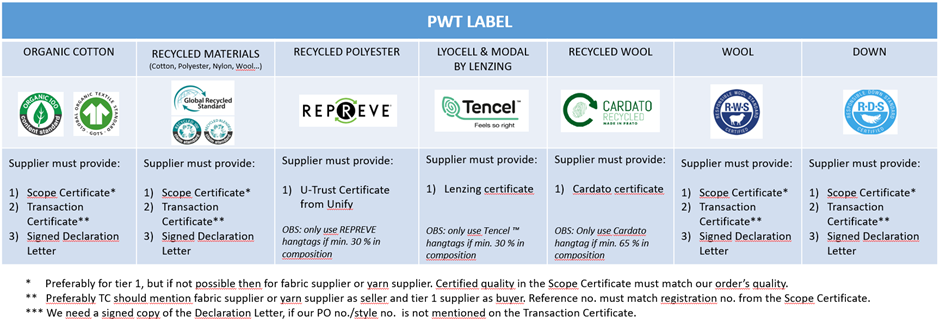
If an order contains organic or recycled material or other certified materials, the supplier must provide documentation as described below: